


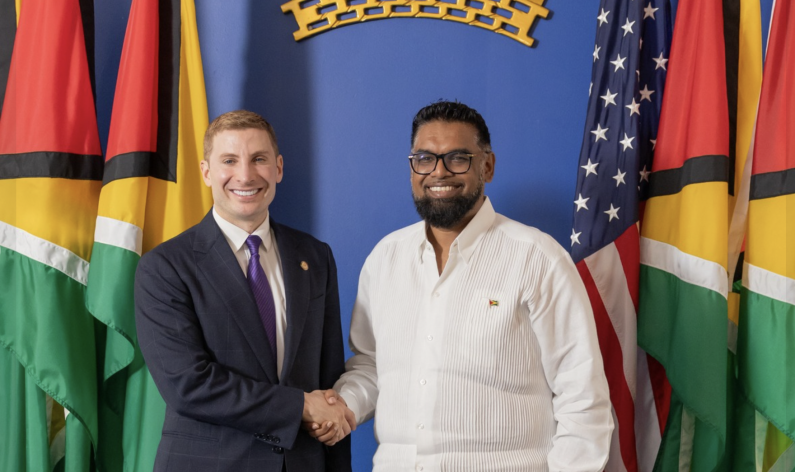
The United States is exploring opportunities to deepen its involvement in Guyana’s bauxite sector and support broader mineral exploration efforts as part of a wider strategy to expand economic cooperation with the South American nation.
The disclosure was made by Jacob Helberg during a press briefing at the U.S. Embassy Georgetown following talks with Irfaan Ali.
- Advertisement -
Helberg said discussions with President Ali focused on attracting additional private investment into Guyana’s bauxite industry, which has experienced significant growth in recent years.
“We talked about the opportunities around bauxite and expanding Guyana’s economic activities in the bauxite sector with additional private investment,” Helberg said.
He noted that infrastructure improvements, including upgraded roads and the possible use of autonomous trucking technology, could help increase production efficiency and move more Guyanese bauxite onto international markets.
Guyana’s bauxite industry posted strong results in 2025, with production rising by an estimated 53.4 percent to 3.9 million tonnes. Export earnings from the sector climbed to approximately US$144.1 million.
Helberg said bauxite was a central topic because Guyana’s reserves are well established and the country already has active investors in the industry.
Beyond bauxite, the U.S. official suggested that Guyana may possess additional untapped mineral resources that could be identified through more advanced geological surveys.
He said Washington is interested in supporting efforts to map mining lands more extensively, particularly in areas believed to contain significant undiscovered reserves.
“Guyana is a country with a lot of natural resources,” Helberg said, adding that increased foreign investment would create the technical and financial capacity needed to carry out sophisticated surveying and resource development.
Helberg also emphasized Guyana’s strategic geographic position and its potential to become a logistics hub linking northern Brazil to the Caribbean and global shipping routes.
He said improved transport infrastructure in Guyana could dramatically reduce shipping times for goods from northern Brazil, allowing cargo to reach the Panama Canal and other markets more efficiently.
“Connecting northern Brazil to the Caribbean through Guyana has an opportunity to shrink time delays by several orders of magnitude,” he said.
According to Helberg, the discussions with President Ali were highly constructive and highlighted what he described as Guyana’s significant potential to attract greater international investment.
With its rapidly growing oil economy, expanding mining sector, and strategic location, Guyana is increasingly drawing attention from global powers seeking to strengthen economic and geopolitical ties in the region.


